Introduction
The buzz around AI search engine optimization has reached a fever pitch. ChatGPT, Perplexity, and other language models have changed how millions of people find information. Yet when we examine actual traffic data from 2026, a surprising pattern emerges: traditional search results and blue links continue to drive significantly more visitors than AI-generated answers.
This reality matters for anyone investing in digital visibility. While AI and search engine optimization have become inseparable topics in marketing discussions, the fundamentals of classic SEO remain the primary driver of organic growth. Understanding this balance helps you allocate resources where they generate real returns.
The question is not whether AI search optimization matters. It does. The real question is how much weight to give emerging channels versus the proven systems that still account for the majority of search-driven traffic. This analysis examines current data, practical implications, and what the evidence tells us about where to focus in 2026.
The Current State of Search Traffic Distribution
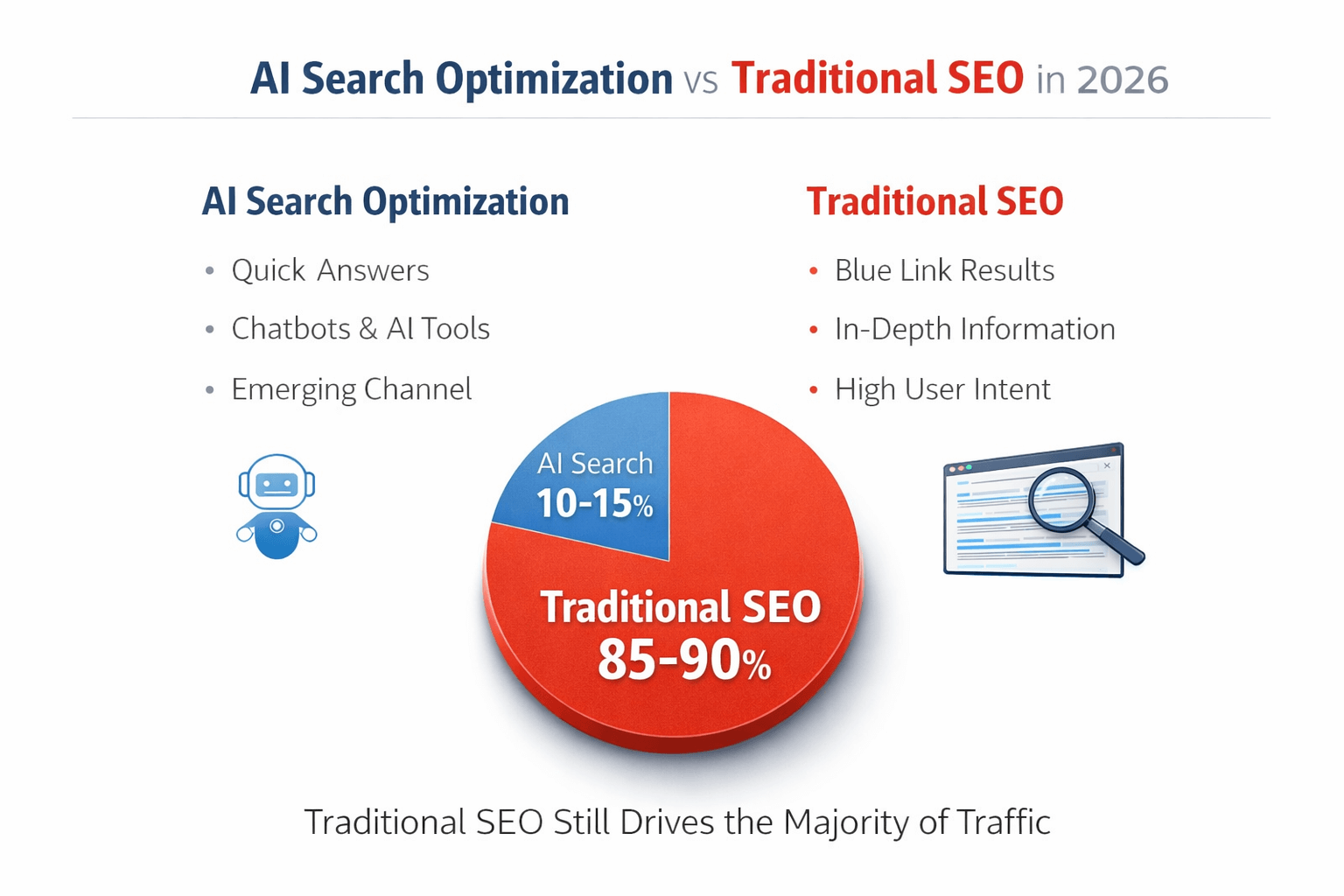
Google processed over 8.5 billion searches per day in early 2026. ChatGPT and similar platforms handle a fraction of that volume. While AI-powered search tools have grown rapidly, they remain supplementary channels for most industries. Data from analytics platforms shows that 85-90% of organic traffic still originates from traditional search engines displaying conventional blue link results.
This gap exists for practical reasons. Most commercial intent searches—people looking to buy, compare, or evaluate products and services—happen in traditional search environments. Users trust these interfaces for transactions and detailed research. AI answers work well for quick facts or summaries, but they lack the depth and variety needed for complex decisions.
The traffic split varies by industry and query type. Informational queries about definitions or simple facts see higher AI answer engagement. Commercial and transactional queries overwhelmingly lead to clicks on traditional results. If your business depends on capturing users ready to take action, optimizing for standard search results remains the priority.
Why Traditional Blue Links Still Dominate
Blue links provide something AI answers cannot: choice. Users see multiple perspectives, compare sources, and select the option that matches their specific need. This autonomy matters for queries where context, credibility, and nuance determine value. A summarized AI response might answer a basic question, but it cannot replace the judgment users apply when evaluating multiple sources.
Commercial queries illustrate this clearly. Someone searching for “project management software” wants to see reviews, pricing pages, feature comparisons, and user testimonials. An AI summary might list options, but it cannot replace the detailed evaluation process that happens when users visit actual websites. This is where traditional search engine optimization continues to generate measurable business outcomes.
Trust also plays a role. Many users remain cautious about AI-generated information, particularly for medical, financial, or legal topics. They prefer to verify claims by visiting source websites. This behavior pattern keeps traditional organic results as the primary conversion path for most industries. Our SEO services focus on capturing this majority traffic channel while preparing for gradual shifts in user behavior.
Understanding AI Search Optimization Tools and Their Role
The market for AI search engine optimization tools has expanded rapidly. These platforms promise to help content appear in AI-generated answers, track visibility in language model responses, and optimize for retrieval-augmented generation systems. Some tools offer genuine value. Others oversell capabilities for channels that generate minimal traffic.
The best AI search optimization tools focus on fundamentals that benefit both traditional and AI search: clear entity definitions, structured data, topical authority, and content organization. These elements help search systems understand what your site covers and why it matters. They improve performance across all search interfaces, not just emerging AI channels.
When evaluating which AI search optimization tool is most intuitive or provides the best data accuracy, consider what metrics actually drive revenue. Tracking AI answer appearances means little if those appearances generate negligible traffic. The most reliable AI search optimization tool for data accuracy measures traditional organic visibility alongside emerging channels, giving you a complete picture of where attention actually flows.
How Search Engine Optimization Using AI Enhances Traditional SEO
The intersection of AI and traditional SEO creates practical advantages. Search engine optimization using AI can identify content gaps, analyze competitor strategies, and suggest structural improvements faster than manual methods. These applications accelerate work that benefits conventional search performance.
AI tools help with entity recognition, showing which concepts search systems associate with your brand. They can map topic clusters, identify missing semantic connections, and suggest internal linking improvements. This work strengthens your site’s relevance signals for both traditional algorithms and language model understanding.
However, the output quality depends on how you apply these insights. AI search optimization services that promise automated solutions often miss the strategic judgment needed to prioritize fixes. The best approach combines AI-assisted analysis with expert interpretation. Our AI search readiness diagnostic uses this hybrid model to identify issues that actually limit visibility.
Generative Engine Optimization and Its Current Limitations
Generative AI search engine optimization, sometimes called GEO, focuses on making content retrievable by language models. The concept has merit. As AI systems improve at citing sources and linking to references, appearing in those citations could drive traffic. But current adoption rates suggest this remains a future opportunity rather than a present priority.
Most language models do not consistently link to sources. When they do, the traffic generated remains modest compared to traditional search. The users asking questions in ChatGPT or similar tools often seek quick answers without clicking through. This behavior pattern limits conversion potential even when your content gets cited.
That said, the principles of generative engine optimization align with sound SEO practices: clear explanations, structured content, authoritative signals, and topic depth. Optimizing for potential AI citations improves traditional search performance as well. The work has value, but it should not displace efforts targeting the channels that currently deliver results.
What Is AI Search Optimization and Why It Matters
What is AI search optimization? The term describes efforts to improve visibility in AI-driven search interfaces, including chatbots, answer engines, and systems that generate responses rather than display links. What is AI search optimization called in different contexts? Some use “GEO” for generative engine optimization. Others refer to “AIO” or “AI answer optimization.”
Regardless of terminology, the goal is consistent: help AI systems understand, retrieve, and reference your content when answering relevant queries. This requires clear topic signals, structured information, and authoritative markers that language models recognize as reliable.
The challenge is balancing investment between emerging and established channels. AI search optimization startups with top visibility metrics often benefit from media attention rather than actual traffic volume. The best platform for AI search optimization competitor analysis shows you where competitors actually gain traction, not just where they get mentioned. This distinction prevents wasted effort on channels that sound innovative but deliver limited returns.
Choosing the Right Tools for Precise Data
The market offers numerous options for tracking search performance across traditional and AI channels. Which AI search optimization tool provides the best data accuracy? The answer depends on what you measure. Some platforms excel at tracking traditional rankings. Others focus on AI answer appearances. Few do both well.
The best AI search optimization software for precise data integrates multiple signals: organic rankings, traffic sources, competitor movements, and emerging channel visibility. Top-rated AI search optimization platforms for data accuracy avoid vanity metrics like “AI mentions” and focus on actionable insights like traffic trends and conversion patterns.
User experience matters too. The best AI search optimization platform for beginners offers clear reports without overwhelming detail. Top user-friendly AI search optimization tools balance depth with accessibility. For teams managing complex sites, the best accurate data platform for AI search optimization provides granular controls and custom reporting. The premier AI tool for search optimization in marketing depends on your specific workflow and objectives.
We maintain tool-agnostic diagnostics because the right platform varies by situation. Our approach focuses on identifying problems first, then selecting tools that address your specific needs rather than forcing generic solutions.
Best Practices for Balancing Traditional and AI Search Optimization
The best rated competitor analysis tools for AI search optimization reveal a pattern: successful sites master traditional SEO fundamentals before expanding to emerging channels. They rank well in conventional search, generate consistent organic traffic, and build authority that transfers across interfaces.
Start with technical health. Crawl errors, indexing problems, and structural issues harm performance everywhere. Fix these first. Then focus on entity clarity and topic organization. These improvements benefit both traditional algorithms and AI understanding. Use best AI visibility analytics for search optimization to track progress across channels without overweighting metrics from low-traffic sources.
Content structure matters more than ever. AI systems and traditional algorithms both reward clear, well-organized information. Use descriptive headings, logical content hierarchies, and explicit topic definitions. This approach, sometimes called profound AI search optimization, creates foundations that work regardless of how search interfaces change.
The key is proportional investment. If traditional search drives 90% of your traffic, allocate most resources there. Monitor AI channels, test optimization approaches, and prepare for growth. But do not sacrifice proven results for speculative opportunities. Our blog covers strategies for maintaining this balance as search continues to shift.
Measuring What Actually Drives Business Results
Analytics clarity separates effective optimization from wasted effort. Track traffic sources carefully. Measure conversion rates by channel. Compare customer acquisition costs across traditional and AI-driven search. This data reveals where investment generates returns.
Many businesses discover that traditional search delivers higher-quality traffic. Users who click through blue links often show stronger commercial intent than those who receive AI-generated answers. They spend more time on site, view more pages, and convert at higher rates. These behavioral differences matter when calculating channel value.
That does not mean ignoring AI search optimization. It means right-sizing expectations and budgets. Test optimization approaches for AI channels. Monitor performance. Scale investment as results warrant. But maintain focus on the channels that currently drive revenue.
The goal is not choosing between traditional and AI search optimization. It is optimizing for both in proportion to their actual impact. This measured approach protects current revenue while preparing for future shifts in user behavior.
The Path Forward for SEO in 2026 and Beyond
Search will continue to change. AI capabilities improve monthly. User habits shift gradually. But the core mechanics of visibility remain consistent: understand what systems value, organize content accordingly, build authority signals, and monitor what works.
The businesses that succeed treat AI search optimization as an extension of traditional SEO rather than a replacement. They apply the same analytical rigor to emerging channels that they use for established ones. They test, measure, and scale based on evidence rather than speculation.
This approach requires ongoing attention. Search algorithms change. AI systems improve. Competitor strategies shift. Regular diagnostics identify new issues before they limit visibility. Contact us to discuss how we can help you maintain performance as search continues to develop.
The future of search is not traditional or AI. It is both, with traditional blue links maintaining dominance while AI channels grow gradually. Success comes from optimizing for the reality we have, not the future we imagine.
Common Questions About AI and Traditional Search Optimization
Does AI search optimization replace traditional SEO?
No. AI search optimization complements traditional SEO but does not replace it. Traditional search engines still drive 85-90% of organic traffic in most industries. AI channels represent growing but supplementary sources. Effective strategies optimize for both while prioritizing channels that generate actual traffic and conversions.
Which metrics matter most for AI search optimization?
Focus on traffic and conversion metrics rather than vanity numbers like AI mentions. Track how many visitors come from AI channels, their engagement rates, and their conversion behavior. Compare these against traditional search performance. If AI channels drive minimal traffic, they warrant minimal investment regardless of mention frequency.
Should small businesses invest in AI search optimization tools?
Small businesses should prioritize traditional SEO first. Master technical health, content organization, and local visibility before expanding to AI channels. Many AI search optimization tools offer limited value for businesses whose customers still find them through conventional search. Invest in AI tools only after securing strong traditional search performance.
How do I know if my content appears in AI-generated answers?
Test by asking relevant questions in ChatGPT, Perplexity, and similar platforms. Track whether they cite your content. However, appearance in AI answers matters less than traffic generated. Many sites get cited without receiving measurable visitors. Monitor actual referral traffic from AI platforms rather than just citation frequency.
What changes first: traditional SEO or AI search optimization?
Work that improves traditional SEO often benefits AI search simultaneously. Clear entity definitions, structured content, topic authority, and quality signals help both traditional algorithms and AI systems understand your site. Start with fundamentals that serve both channels rather than choosing one over the other.
Are there industries where AI search already dominates?
Not yet. Even for simple informational queries where AI answers work well, traditional search results still capture the majority of traffic. Some query types see higher AI engagement, particularly quick fact checks and definitions. But commercial intent searches overwhelmingly favor traditional results across all industries.
Take Action on What Drives Results Today
The data is clear. Traditional search engine optimization continues to generate more traffic, more conversions, and more revenue than AI channels for the vast majority of businesses. This does not mean ignoring AI search optimization. It means investing proportionally based on actual impact.
Start by understanding where you stand. Audit your technical SEO health, content structure, and authority signals. These fundamentals determine performance across all search interfaces. Then evaluate emerging channels based on your specific industry and audience behavior.
If you need clarity on what to prioritize, we offer focused diagnostics that identify real visibility issues without generic recommendations. Read what our clients say about the clarity this approach provides. Then schedule a diagnostic to see where your site stands and what changes would actually move results.